Choosing the right domain extension is an important part of building your business online. Your domain is not just a website address—it becomes part of your brand identity, marketing, customer recognition, and long-term digital presence.
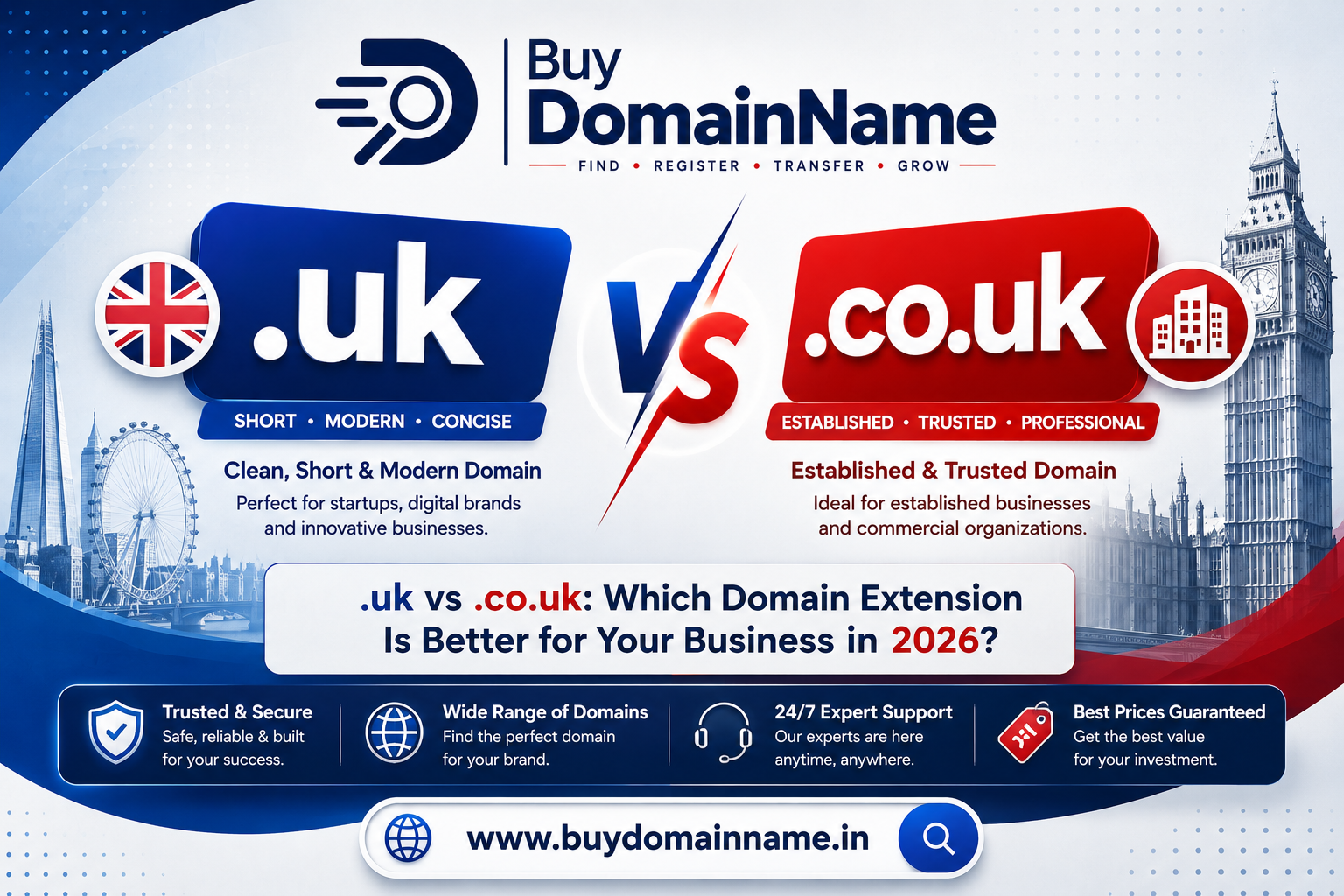
For businesses targeting customers in the United Kingdom, two popular choices are .uk and .co.uk.
Both extensions have a strong UK identity, but they create slightly different impressions. .co.uk has decades of familiarity among UK businesses and consumers, while .uk offers a shorter and more contemporary alternative.
So, which one should you choose in 2026?
In this guide, we’ll compare .uk vs .co.uk based on branding, SEO, trust, memorability, email, domain availability, business suitability, and long-term brand protection—with BuyDomainName.in as your destination for finding the right domain.
.uk vs .co.uk: Quick Comparison
| Feature | .uk | .co.uk |
|---|---|---|
| Domain Type | UK country-code domain | UK commercial second-level domain |
| Branding | Short, modern and concise | Established and familiar |
| Business Perception | Contemporary and digital-first | Traditional and established |
| UK Recognition | Increasingly familiar | Very high |
| Domain Length | Shorter | Longer |
| Marketing | Compact and easy to display | Highly recognizable |
| SEO | No inherent advantage | No inherent advantage |
| UK Relevance | Strong | Strong |
| Best For | Startups, digital businesses, modern brands | Established businesses and commercial websites |
| Brand Protection | Useful alongside .co.uk | Useful alongside .uk |
The key difference isn’t technical performance. It’s how each extension fits your brand and audience.
What Is a .uk Domain?
The .uk domain is the direct country-code domain extension for the United Kingdom.
Unlike .co.uk, which contains the additional “co” label, a .uk domain goes directly from the business name to the UK identifier.
For example: yourbusiness.uk
compared with: yourbusiness.co.uk
Direct .uk registrations became available in 2014, giving UK businesses another option for establishing their online identity.
One of the biggest advantages of .uk is its short structure.
A shorter domain can be convenient for:
- Business cards
- Social media
- Packaging
- Advertisements
- Signage
- Email addresses
- Digital marketing
However, shorter doesn’t automatically mean better. .co.uk has decades of familiarity behind it, which remains valuable for established businesses.
What Is a .co.uk Domain?
The .co.uk domain is one of the most recognizable commercial domain extensions associated with the United Kingdom.
The “co” historically represents commercial use, while “uk” identifies the United Kingdom.
For many years, UK businesses have used .co.uk as their standard online address. As a result, many British consumers are naturally familiar with seeing a business name followed by .co.uk.
That familiarity is one of the extension’s biggest strengths.
For an established company that has already built its reputation around a .co.uk domain, changing simply because .uk is shorter may create unnecessary disruption.
For a new business, however, the decision is much more flexible.
.uk vs .co.uk: Branding and Customer Perception
Your domain is one of the first pieces of information customers see.
It can appear in:
- Google search results
- Email addresses
- Advertisements
- Social media profiles
- Business cards
- Invoices
- Packaging
- Offline signage
That makes your domain extension part of your overall brand identity.
.uk Branding
The .uk extension has a concise and modern appearance.
For a startup, technology company, creator, or digital-first business, the shorter format can create a contemporary identity.
For example:
brand.uk
looks clean and compact.
.co.uk Branding
The major strength of .co.uk is familiarity.
UK customers have seen .co.uk domains for decades. For an established retailer, professional service provider, or traditional company, that recognition can be valuable.
Our View
If you’re launching a new UK-focused brand and both domains are available, .uk can be an attractive choice for a shorter, modern identity.
If you already have a successful .co.uk brand, there is usually little reason to change simply because .uk is shorter.
Does .uk Rank Better Than .co.uk?
This is one of the biggest questions businesses ask.
The short answer is:
Don’t choose .uk expecting an automatic SEO advantage.
Neither .uk nor .co.uk should be treated as a shortcut to higher Google rankings.
Search visibility depends on factors such as:
- Content quality
- Search intent
- Technical SEO
- Backlinks
- Website architecture
- Page experience
- Mobile usability
- Website performance
- Internal linking
- Overall relevance
Both .uk and .co.uk communicate a strong connection with the UK.
So if you’re targeting UK customers, either extension can form part of an effective UK-focused SEO strategy.
Choose your domain based on branding and business strategy—not an assumed SEO boost.
Which Domain Is More Trustworthy: .uk or .co.uk?
Trust is strongly influenced by familiarity.
The .co.uk extension has been used by UK businesses for decades. Consumers have encountered it across:
- Retail websites
- Professional firms
- Local businesses
- Service providers
- Ecommerce stores
This gives .co.uk a significant familiarity advantage.
The .uk extension is also a legitimate and established UK domain and can look highly professional for a new business.
However, an established business should consider the value of its existing .co.uk identity before changing domains.
If customers already recognize: yourcompany.co.uk
moving to: yourcompany.uk
could create unnecessary confusion.
.uk vs .co.uk for Business Email
Your domain isn’t only used for your website. It also becomes part of your professional email address.
For example: hello@yourbusiness.uk or hello@yourbusiness.co.uk
Both can provide a professional branded email identity.
The most important factor is consistency.
If your website uses .uk but your email uses .co.uk, customers may wonder whether both addresses belong to the same company.
Regardless of which extension you choose, businesses should also properly configure email authentication technologies such as:
- SPF
- DKIM
- DMARC
A professional domain combined with properly configured email authentication provides a stronger foundation for business communication.
Is .uk Better Because It Is Shorter?
There is a genuine advantage to a shorter domain.
A .uk address can take up less space on:
- Advertisements
- Social media graphics
- Printed materials
- Product packaging
- Business cards
- Promotional banners
It can also be easier to communicate verbally.
However, memorability isn’t determined by length alone.
A simple, recognizable .co.uk domain may be easier for an existing UK audience to remember than an unfamiliar .uk address.
For a new brand, however, there is no existing customer expectation. That makes .uk particularly attractive.
Domain Availability: Why .uk Can Be Attractive
Domain availability is one of the strongest reasons businesses consider .uk.
Many short and memorable .co.uk names have already been registered.
A business may discover that: yourbrand.co.uk
is unavailable while: yourbrand.uk is available.
This can allow a startup to secure a concise domain without adding:
- Extra words
- Numbers
- Hyphens
- Unnecessary abbreviations
However, availability shouldn’t be the only consideration.
If an existing business is strongly associated with your desired .co.uk name, registering the .uk version could potentially create brand confusion.
Before registering a domain, consider:
- Trademark availability
- Existing businesses
- Social media availability
- Brand conflicts
- Customer perception
When Should You Choose a .uk Domain?
A .uk domain can be a strong fit when you’re building a new UK-focused brand and want a shorter digital identity.
Choose .uk if:
- You’re launching a new UK business
- You want a shorter domain
- You’re building a modern brand
- You’re running a digital-first business
- Your preferred .co.uk domain is unavailable
- You want a concise branded email address
The important point is that the domain name itself should also be strong.
A short domain with a confusing business name isn’t automatically better than a slightly longer domain customers can easily understand.
When Should You Choose a .co.uk Domain?
For many UK commercial businesses, .co.uk remains an excellent choice.
Its biggest advantage isn’t technical.
It’s familiarity.
Choose .co.uk if:
- You’re targeting UK consumers
- You want established brand recognition
- Customers already know your .co.uk address
- You’re operating a traditional commercial business
- You’re a retailer or professional service provider
- Your preferred .co.uk name is available
For an established business, continuity can be more valuable than having a shorter URL.
.uk vs .co.uk for Startups
Startups generally have more flexibility because they don’t have an existing audience tied to an established domain.
That makes .uk particularly interesting.
A startup can build its:
- Website
- Social media
- Advertising
- Packaging
- Brand identity
around a short .uk domain from day one.
However, if the exact .co.uk version is available and fits the brand, it can provide immediate familiarity among UK customers.
The best choice depends on the startup’s ambitions.
If the company intends to remain strongly UK-focused, either extension can work.
If the company expects international expansion, it may also be worth considering how its UK domain will fit alongside a .com or other international domain.
.uk vs .co.uk for Ecommerce
Ecommerce businesses should pay particular attention to customer trust.
Customers are entering:
- Personal information
- Delivery details
- Payment information
A familiar .co.uk address can feel natural to UK shoppers, particularly for established retailers.
A .uk domain can also work well for modern ecommerce brands when the domain is short and memorable.
But the domain extension alone does not create trust.
Ecommerce businesses should also focus on:
- HTTPS
- Secure payment processing
- Clear contact information
- Customer reviews
- Transparent policies
- Professional website design
- Reliable hosting
- Strong website security
The domain is one part of the overall customer experience.
.uk vs .co.uk for Local Businesses
For local UK businesses, both extensions can communicate geographic relevance.
For example:
- London agencies
- Manchester service businesses
- Birmingham retailers
- UK-based consultants
- Local tradespeople
can use either extension.
However, local SEO isn’t determined by the domain extension alone.
Important local SEO factors include:
- Google Business Profile
- Location information
- Website content
- Reviews
- Local citations
- Backlinks
- Structured data
- Location landing pages
- Overall relevance
A .uk or .co.uk domain can reinforce your UK identity, but it shouldn’t replace a proper local SEO strategy.
Should You Register Both .uk and .co.uk?
If your budget allows and both versions are available, registering both can be a smart brand-protection strategy.
For example:
Primary: yourbusiness.uk
Secondary: yourbusiness.co.uk
You can redirect the secondary domain to your primary website.
This can help prevent someone else from registering the corresponding version and potentially confusing customers.
You don’t need to operate two separate websites.
One can remain your primary domain while the other redirects to it.
The key is to maintain one canonical website and consistent branding.
Which Extension Does Google Prefer?
Don’t choose .uk or .co.uk simply because you believe Google prefers one over the other.
Search engines evaluate a wide range of signals.
These include:
- Content
- Relevance
- Technical optimization
- Website authority
- Links
- Performance
- User experience
Both .uk and .co.uk provide a strong UK identity.
A poorly optimized .uk website will not automatically outrank a well-built .co.uk website.
Likewise, .co.uk does not receive a free SEO advantage simply because it has been around longer.
Your domain should support your brand strategy, while your SEO strategy should focus on the quality and relevance of your website.
Common Mistakes When Choosing Between .uk and .co.uk
1. Choosing Whatever Is Available
Don’t select a domain purely because it happens to be available.
Think about the brand first.
2. Assuming Shorter Always Means Better
A short domain is useful, but it still needs to be recognizable and easy to communicate.
3. Ignoring Trademarks
A domain being available doesn’t automatically give you unrestricted rights to use the associated business name.
4. Choosing Only Based on Price
A cheaper domain isn’t necessarily the better long-term business asset.
5. Ignoring Existing Brand Recognition
If your customers already know your .co.uk domain, switching can create unnecessary disruption.
6. Forgetting Brand Protection
If both versions are available and strategically important, registering both may be worthwhile.
.uk vs .co.uk: Which One Should You Choose in 2026?
There isn’t a universal winner.
Choose .uk if:
- You’re launching a new UK business
- You want a short, modern domain
- You’re building a digital-first brand
- You’re a startup or creator
- Your preferred .co.uk domain isn’t available
Choose .co.uk if:
- You’re targeting UK consumers
- You want maximum familiarity
- You’re an established business
- Customers already recognize your .co.uk address
- You operate a traditional commercial business
- The exact .co.uk domain is available
Consider Both if:
- Your brand is strategically important
- Both domains are available
- You want stronger brand protection
- You have the budget
- You want to prevent customer confusion from competing registrations
Final Verdict: .uk or .co.uk?
The .uk vs .co.uk decision doesn’t have a universal winner.
.co.uk has the advantage of familiarity, history, and strong recognition among UK audiences. It remains an excellent option for established businesses, retailers, professional services, and companies that want a traditional UK commercial identity.
.uk offers a shorter, cleaner, and more contemporary domain structure. It can be particularly attractive for startups, digital-first companies, creators, and businesses launching a new UK-focused brand.
From an SEO perspective, don’t expect either extension to provide a shortcut to higher rankings.
If you’re starting a new business and both versions are available, compare them based on your brand strategy, target audience, and long-term plans.
If you already have a successful .co.uk brand, don’t migrate simply because .uk looks newer.
And if your budget allows, consider registering both to protect your brand and redirecting the secondary domain to your primary website.
Ultimately, the right domain is the one your customers can remember, trust, and associate with your business for years to come.
Find Your Perfect Domain at BuyDomainName.in
Your domain is more than a website address. It’s a long-term digital brand asset.
Whether you’re launching a UK-focused startup, ecommerce store, local business, professional service, technology company, or online platform, choosing the right domain is an important first step.
At BuyDomainName.in, you can search for available domain names and find the extension that fits your business strategy.
Looking for a concise UK identity?
Explore .uk domains.
Want the familiarity of the traditional UK commercial extension?
Check .co.uk domains.
Want to protect your brand?
Consider registering both.
Start your domain search today at www.buydomainname.in and secure a domain name that can grow with your business.