
The internet continues to expand every day. New businesses launch websites, startups register brand names, developers build new applications, ecommerce stores move online, and individuals create digital identities.
Behind many of these online journeys is one important asset: a domain name.
From familiar extensions such as .com and .net to country-specific domains like .in and .uk, and newer extensions such as .ai, .tech, .shop, and .app, there are now thousands of domain options available.
But exactly how many domains are there in the world in 2026?
In this guide, we’ll look at the latest domain statistics, explain how domain registrations differ from websites, explore the major types of domain extensions, and explain what these numbers mean for businesses and individuals looking to register a domain.
How Many Domains Are There in the World in 2026?
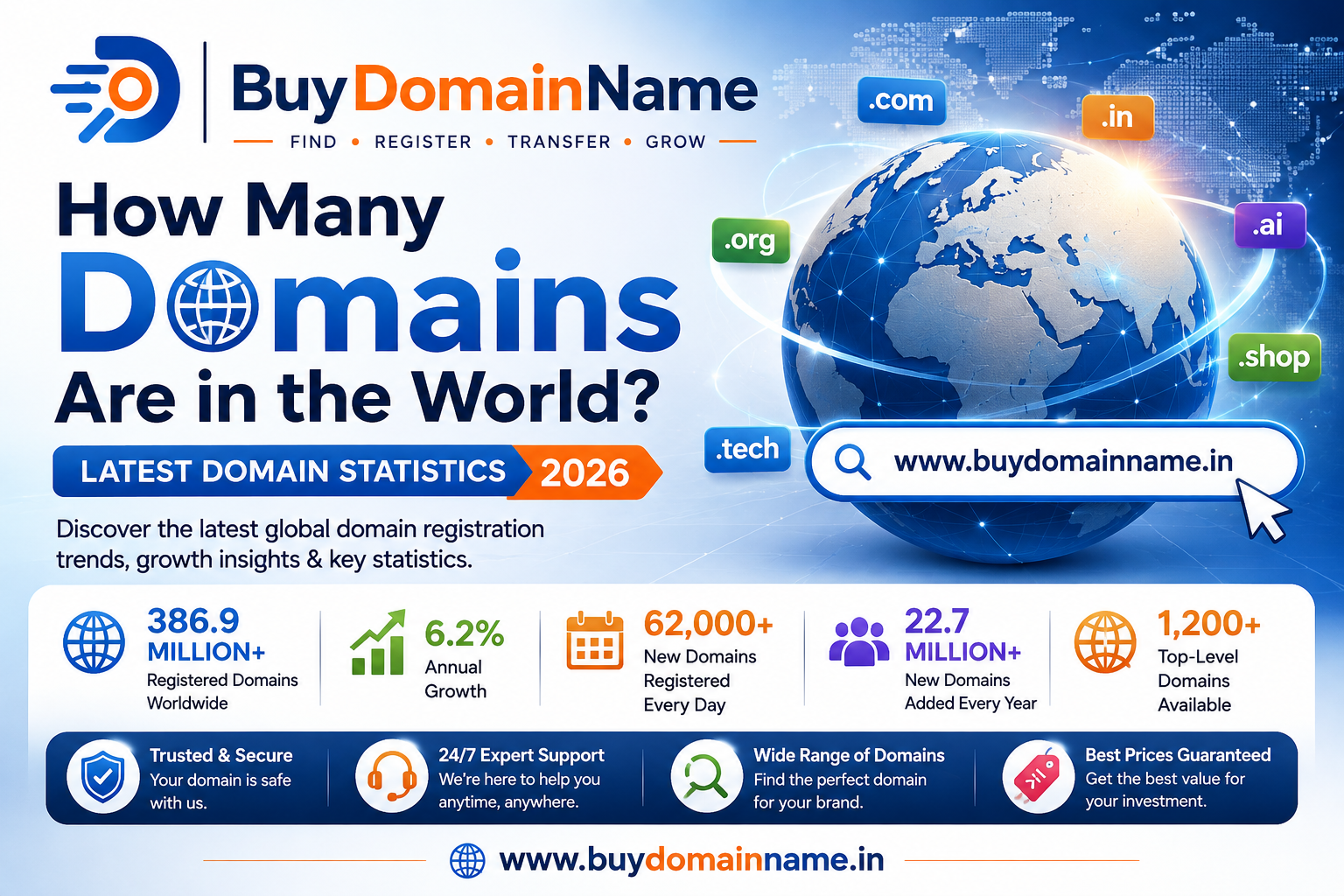
As of 2026, there are approximately 386.9 million registered domain names worldwide.
The global domain industry continues to grow as businesses, startups, ecommerce stores, developers, and individuals establish their online presence.
According to the source statistics:
- 386.9 million registered domains worldwide
- 6.2% annual growth
- Approximately 62,000 net new domains added daily
- More than 22.7 million net new domains added annually
- More than 1,200 Top-Level Domains (TLDs) available
These figures include registered domains across generic TLDs, country-code TLDs, and newer domain extensions.
Global Domain Registration Snapshot 2026
| Domain Statistic | 2026 Figure |
|---|---|
| Registered Domains Worldwide | ~386.9 million |
| Annual Growth | 6.2% |
| Net New Domains Per Day | ~62,000 |
| Net New Domains Per Year | ~22.7 million |
| Available TLDs | 1,200+ |
The important word here is registered.
These figures represent currently registered domains, not every domain that has ever existed.
Domains can expire, be deleted, transferred, or registered again, so the total number changes continuously.
How Many Registered Domain Names Exist Right Now?
The estimated 386.9 million registered domains cover a wide range of extensions.
These include established domains such as:
- .com
- .net
- .org
Country-specific domains such as:
- .in
- .uk
- .de
- .jp
- .au
And newer domain extensions such as:
- .shop
- .app
- .tech
- .ai
- .store
- .online
The continued increase in registrations reflects the growing importance of having an online presence. Businesses register domains for websites, email, branding, future projects, marketing campaigns, and brand protection.
Does Every Registered Domain Have a Website?
No.
This is an important distinction.
A registered domain doesn’t necessarily have an active website attached to it.
Someone may register a domain for:
- A future business
- Brand protection
- Professional email
- Domain investment
- Resale
- Redirecting traffic
- A future product or project
Some domains are parked or simply held without an active website.
Therefore:
Registered domains ≠ active websites
The number of domain registrations tells us how many domain names are currently registered, not how many websites are actively being used.
Domain Name vs Website: What’s the Difference?
Many people use the terms “domain” and “website” interchangeably, but they are different things.
A Domain Name
A domain is the unique address visitors type into a browser.
For example:
example.com
A Website
A website is the collection of:
- Web pages
- Images
- Videos
- Files
- Applications
- Databases
that visitors access through the domain.
A Simple Example
Think of it like this:
Domain name = street address
Website = building at that address
You can register a domain without immediately building a website.
How Many Websites Are There?
The source estimates that there are more than 1.1 billion websites on the internet, although only around 18–20% are considered active.
This can initially seem confusing.
If there are approximately 386.9 million registered domains, how can there be more than 1.1 billion websites?
The answer is that websites and domains aren’t one-to-one.
There are several reasons for the difference.
Why Are There More Websites Than Domains?
1. One Domain Can Have Multiple Subdomains
A single domain can support multiple subdomains.
For example:
blog.example.com
store.example.com
support.example.com
developers.example.com
These can serve different functions or applications while remaining under one primary domain.
Large companies commonly use subdomains to organize different services and sections of their online presence.
2. Many Registered Domains Don’t Host Active Websites
Millions of domains are registered but don’t have an active website.
They may be:
- Parked
- Reserved for future projects
- Used only for email
- Held for brand protection
- Purchased for resale
So registering a domain doesn’t necessarily mean building a website immediately.
3. Free Website Platforms Use Shared Domains
Many websites are created on platforms that provide a website address under an existing domain.
Examples include:
username.wordpress.com
myshop.shopify.com
username.github.io
project.netlify.app
These websites contribute to the overall number of websites without each one requiring a separately registered custom domain.
How Many Types of Domain Extensions Are There?
The modern internet offers more than 1,200 Top-Level Domains (TLDs).
These fall into several major categories.
1. Generic Top-Level Domains (gTLDs)
Generic TLDs are among the most widely recognized domain extensions.
Popular examples include:
- .com
- .net
- .org
- .info
- .biz
Among these, .com remains the most popular, representing approximately 40% of all registered domains according to the source material.
Why Is .com So Popular?
The .com extension has been used for decades and is widely recognized by businesses and internet users around the world.
It is commonly associated with:
- Businesses
- Ecommerce
- Startups
- Professional services
- International companies
For businesses targeting a global audience, .com remains a strong default choice.
2. Country-Code Top-Level Domains (ccTLDs)
Country-code TLDs are associated with individual countries or territories.
Examples include:
- .in — India
- .uk — United Kingdom
- .de — Germany
- .jp — Japan
- .au — Australia
These extensions can help communicate a specific geographic market.
For example: brand.in
can clearly communicate an Indian connection.
Likewise: brand.co.uk
can create a strong UK-focused identity.
Some country-code extensions have also become popular globally because of their branding potential. Examples include .ai, .io, and .co.
3. New Generic Domain Extensions
The expansion of the domain namespace has created many new branding opportunities.
Some popular examples include:
- .tech
- .app
- .shop
- .store
- .online
- .blog
- .cloud
- .dev
These extensions can be particularly useful when the preferred .com domain is unavailable.
For example: yourbrand.com
might already be registered.
Instead, a business could consider a relevant alternative such as:
yourbrand.tech for a technology business, or: yourbrand.shop
for an ecommerce store.
The extension can become part of the brand positioning.
How Many Domains Are Registered Every Day?
The current estimate is approximately 62,000 net new domain names added every day.
The word net is important.
This figure represents growth after accounting for domains that expire or are deleted. It isn’t necessarily the total number of registrations processed by registrars each day.
At that rate, the global domain industry adds approximately:
22.7 million net domains per year.
That is a significant amount of new digital real estate being secured every year.
Why Are Domain Registrations Growing?
Several major trends are driving domain registration growth.
1. Ecommerce Growth
Businesses increasingly need online stores and digital sales channels.
A memorable domain becomes an important part of an ecommerce brand.
2. Startup Growth
Startups often register domains before launching their products.
The domain may become the foundation of the company’s digital identity.
3. AI Businesses
The rapid growth of AI companies has created additional demand for technology-focused domains, including .ai and other relevant extensions.
4. SaaS Growth
Software-as-a-Service companies need websites, product portals, documentation, and marketing platforms.
5. Digital Transformation
Traditional businesses are increasingly moving their operations online.
6. Brand Protection
Businesses often register multiple domains to protect their company name across different extensions.
7. Increasing Internet Adoption
As more people and businesses establish online identities, demand for domains continues to expand.
Can One Domain Host Multiple Websites?
Yes.
There are several ways to run multiple websites or web experiences using a single domain.
Subdomains
For example:
blog.company.com
support.company.com
careers.company.com
Each can serve a different purpose.
Subdirectories
You can also organize content under the same domain:
company.com/blog
company.com/shop
company.com/help
Multiple Domains on One Hosting Account
Many hosting providers also allow multiple domains to be hosted under one hosting account, depending on the hosting plan and configuration.
This can make it easier to manage multiple websites or projects from one hosting environment.
How Many Domains Should a Business Buy?
There is no fixed number of domains a business needs.
For a simple personal website, one domain may be enough.
A growing business may register several domains for strategic reasons.
For example:
- Protecting the primary brand
- Securing common spelling variations
- Registering country-specific domains
- Supporting future products
- Protecting important brand extensions
- Preventing competitors from acquiring similar names
However, buying dozens of domains without a clear strategy can become unnecessary expense.
The better approach is to register domains that have a specific business purpose.
How to Choose the Right Domain Extension
The best domain extension depends on your target audience, industry, and brand strategy.
Choose .com
If you want maximum global recognition.
Choose .in
If your primary audience and business operations are focused on India.
Choose .tech
If you’re building a technology-focused business.
Choose .shop or .store
If you’re launching an ecommerce business.
Choose .app
If you’re building a mobile or web application.
The right extension should support your brand rather than being selected simply because the domain is available.
What Does 386.9 Million Domains Mean for Businesses?
The number of registered domains tells us something important:
Good domain names are valuable digital assets.
As more businesses enter the internet, desirable names become increasingly competitive.
If you have already decided on a business or brand name, delaying domain registration can create unnecessary risk.
Someone else may register the domain before you.
This is particularly important when:
- Launching a startup
- Registering a new company
- Launching an ecommerce brand
- Introducing a new product
- Building a personal brand
Securing the domain early can help establish and protect your online identity.
Should You Register Multiple Domain Extensions?
For an important brand, registering multiple relevant extensions can make sense.
For example, an India-focused business might consider:
brand.in
alongside another relevant domain extension.
An international business may consider:
brand.com
and relevant country-specific domains as it expands.
An ecommerce company might also consider securing a relevant .shop or .store domain.
The objective isn’t to collect domains.
The objective is to protect the brand and support the business strategy.
Final Thoughts
The global domain industry continues to expand as businesses and individuals invest in their digital presence.
With approximately 386.9 million registered domains, more than 1,200 domain extensions, and around 62,000 net new domains being added every day, the competition for valuable domain names is significant.
Whether you’re launching a startup, ecommerce store, technology company, personal brand, or local business, your domain is one of the first digital assets you should secure.
The important thing isn’t simply finding an available domain.
You need a domain that is:
- Memorable
- Easy to spell
- Easy to communicate
- Relevant to your brand
- Suitable for your target audience
- Capable of supporting future growth