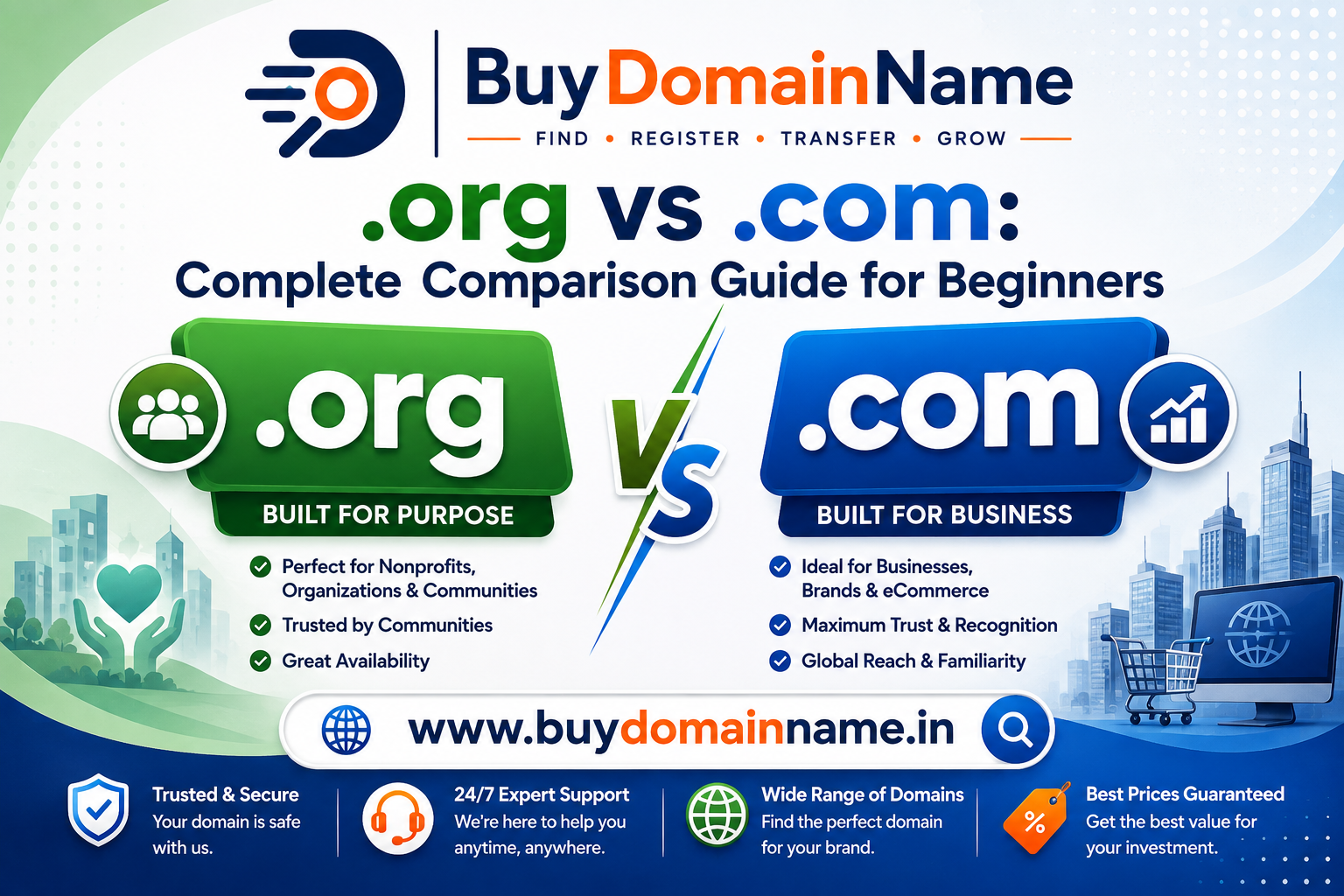
Choosing the right domain extension is one of the first branding decisions you make when building a website. While there are now thousands of domain extensions available, .org vs .com remains one of the most common comparisons for businesses, organizations, communities, creators, and website owners.
The difference may look small because it appears at the end of a web address, but the extension can influence how visitors perceive your website before they even open it.
A .com domain is strongly associated with businesses, commercial websites, ecommerce stores, SaaS platforms, and global brands, while .org has traditionally been connected with nonprofit organizations, communities, educational initiatives, charities, and open-source projects.
That doesn’t mean .com is only for businesses or .org is legally restricted to nonprofits. Both are widely accessible domain extensions. The real question is:
Which extension best matches your website and brand?
In this guide, we’ll compare .org vs .com across branding, trust, SEO, availability, pricing, business use, memorability, and long-term brand strategy.
.org vs .com: At a Glance
| Feature | .com | .org |
|---|---|---|
| Original Purpose | Commercial organizations | Organizations and communities |
| Common Association | Businesses and commercial brands | Nonprofits, communities, education and causes |
| Availability | Highly competitive | Generally more availability for desirable names |
| Brand Recognition | Extremely high | High, especially for mission-driven organizations |
| Consumer Expectation | Commercial or general-purpose website | Organization, community or cause |
| Registration Restrictions | No general eligibility restriction | No general eligibility restriction |
| SEO Impact | No inherent ranking advantage | No inherent ranking advantage |
| Best Suited For | Businesses, ecommerce, SaaS and global brands | Nonprofits, charities, communities and open-source projects |
| Global Suitability | Excellent | Excellent |
The important point is that neither extension automatically makes a website successful. Your domain should support your brand, while your website needs to provide the content, experience, security, and performance visitors expect.
What Is a .com Domain?
The .com domain is one of the most recognized domain extensions on the internet.
The abbreviation originally referred to “commercial,” but its use has expanded significantly over the years. Today, businesses, startups, ecommerce stores, SaaS platforms, agencies, creators, publishers, and individuals commonly use .com domains.
This widespread adoption has made .com feel like the default web address.
When someone hears a company name and tries to visit its website, there is a good chance they will instinctively add “.com” to the name.
That familiarity is one of the biggest advantages of the extension.
According to the source material, .com represented more than 37% of the overall domain market share in December 2025, demonstrating how dominant the extension remains.
However, that popularity also creates a challenge: Availability.
Many short, simple, and memorable .com domains have already been registered.
Why Do Businesses Prefer .com?
A .com domain immediately feels familiar to most internet users.
Customers don’t need to learn what the extension means because they have encountered it countless times.
A company using a .com domain can also create a straightforward global identity without appearing tied to a particular country.
For example, an ecommerce company planning to sell products across several markets may find .com particularly suitable because the extension doesn’t communicate a specific geographic market.
The same applies to:
- SaaS companies
- Technology businesses
- Digital agencies
- Online publications
- Professional service providers
- Ecommerce brands
- Global startups
However, the popularity of .com doesn’t mean every website should use it.
The purpose of your organization should remain the primary consideration.
What Is a .org Domain?
The .org domain traditionally represents “organization” and has long been associated with:
- Nonprofit organizations
- Charities
- Communities
- Educational initiatives
- Open-source projects
- Mission-driven organizations
Unlike some specialized domain extensions, .org generally does not require an organization to prove nonprofit status before registering a domain.
This means businesses and individuals can technically register .org domains as well.
But technical availability and audience perception are two different things.
When people see a .org domain, they may expect the website to represent a community, organization, educational project, public-interest initiative, or nonprofit cause.
That expectation can be valuable when it matches the actual purpose of the website.
.org vs .com: Why Does the Domain Extension Matter?
Your domain is more than a technical address.
It is part of your brand.
Imagine seeing: brandname.com and brandname.org
Even before visiting either website, you may form different expectations.
The .com version can feel commercial and business-oriented.
The .org version can feel community-focused or mission-driven.
This perception doesn’t automatically determine whether a website is trustworthy. It simply creates an expectation.
That’s why your domain extension should be connected to what your organization actually does.
.com vs .org: Detailed Comparison
1. Brand Recognition
The .com extension has an enormous recognition advantage.
It has been used by businesses and organizations for decades and has become deeply embedded in internet culture.
Users often recognize .com without consciously thinking about it.
The .org extension is also widely recognized, but its recognition is more closely associated with organizations, nonprofits, education, communities, and causes.
This doesn’t make .org weaker.
It makes its branding more specific.
For a commercial company, .com usually creates the more natural first impression.
For a nonprofit or community organization, .org can communicate the organization’s purpose more effectively.
2. Trust and Credibility
Trust is subjective, but familiarity plays a major role.
Consumers are highly familiar with .com, while .org has strong associations with philanthropic and organizational purposes.
A consumer shopping online may naturally expect a commercial website to use .com.
Someone visiting a charity website may find .org equally—or more—appropriate because the extension reinforces the organization’s mission.
In other words:
The strongest domain isn’t necessarily the one with the highest general recognition.
It’s the one that creates the right expectation for your audience.
3. SEO: Does .com Rank Better Than .org?
This is one of the most important misconceptions beginners need to understand.
A .com domain does not automatically receive higher Google rankings simply because it ends in .com.
Likewise, choosing .org doesn’t create an automatic SEO disadvantage.
Search engines evaluate many factors, including:
- Relevance
- Content quality
- Website structure
- Backlinks
- Technical performance
- Page experience
- Mobile usability
- Website authority
- Search intent
The domain extension itself should not be treated as an SEO shortcut.
A well-optimized .org website can outrank a poorly optimized .com website.
A strong .com website can outrank a weak .org website.
What matters is what you build around the domain.
4. Does .com Have Better Click-Through Rates?
SEO ranking and user behavior are not the same thing.
Even when two domains receive the same treatment from search engines, users may respond differently to the addresses they see.
The familiarity of .com can influence whether users recognize and remember a website.
Someone seeing a company name followed by .com may immediately interpret it as a conventional commercial website.
A .org domain may create a different expectation.
However, this doesn’t mean .com automatically produces higher click-through rates in every situation.
A .org domain can be highly compelling when users expect a:
- Nonprofit
- Community
- Educational organization
- Public-interest initiative
- Mission-driven organization
The key takeaway is:
Domain perception can influence user behavior even when the extension itself isn’t a direct ranking factor.
5. Domain Availability
This is where .org can become attractive to businesses and organizations struggling to find a suitable .com name.
The popularity of .com means that many short and brandable names have already been registered.
You might discover: yourbrand.com is unavailable while: yourbrand.org is still available.
That can make .org appear attractive.
But availability should never be your only consideration.
If you’re running a commercial business, choosing .org simply because the .com version is unavailable can create confusion about what your organization actually does.
Instead, evaluate the complete brand.
You could:
- Explore another strong .com name
- Consider another relevant domain extension
- Evaluate whether .org genuinely fits your organization
The cheapest available domain isn’t necessarily the best domain.
6. .com vs .org Pricing
Domain pricing varies depending on:
- Registrar
- Promotions
- Registration period
- Renewal policies
- Domain extension
- Premium domain status
The initial registration price also doesn’t necessarily tell you what you’ll pay over several years.
That’s why businesses should compare both registration and renewal pricing before making a decision.
Don’t choose an extension solely because the first-year price appears cheaper.
Your domain is a long-term digital asset.
A small difference in annual pricing is generally less important than choosing a domain that properly supports your brand.
At BuyDomainName.in, always check the current registration and renewal pricing before completing your domain purchase.
7. .com vs .org Resale Value
The domain aftermarket is another area where .com has historically had a major advantage.
Highly desirable .com domains can command significant prices because businesses and investors place substantial value on short, memorable commercial domains.
That doesn’t mean every .com domain is valuable.
Most aren’t.
However, the strongest .com domains have historically enjoyed substantial demand.
.org domains can also have value, particularly when the name is highly relevant to:
- Nonprofits
- Communities
- Technology
- Open-source projects
- Public-interest organizations
If domain resale value is an important part of your strategy, .com generally has the stronger historical market position.
When Should You Choose a .com Domain?
A .com domain is usually the natural choice when your website represents a commercial or broadly consumer-facing business.
It can work particularly well when you want your brand to operate across different markets without being associated with a particular country.
A .com domain makes sense when:
- You’re launching a commercial business
- You’re building an ecommerce store
- You’re creating a SaaS product
- You’re running a professional service company
- You’re developing a global brand
- You’re building a commercial personal brand
- You want maximum mainstream domain recognition
- Your ideal .com name is available
For most commercial startups, .com should at least be considered before choosing another extension.
When Should You Choose a .org Domain?
A .org domain can be an excellent fit when your organization’s identity is built around a mission, community, educational purpose, or public-interest initiative.
The extension can reinforce what your website represents before visitors even read the content.
A .org domain makes sense when:
- You’re operating a nonprofit organization
- You’re building a charitable initiative
- You’re creating an educational community
- You’re running an open-source project
- You’re managing a community organization
- You’re developing a public-interest platform
- Your brand identity is strongly mission-driven
The key is alignment.
When the .org extension naturally matches the purpose of the website, it becomes a branding asset rather than simply an alternative to an unavailable .com.
.org vs .com for Nonprofits
For nonprofit organizations, .org has an obvious branding advantage.
The extension communicates organizational and mission-driven intent.
When someone sees a nonprofit using a .org domain, the domain itself reinforces what the organization represents.
That doesn’t mean a nonprofit cannot use .com.
Some nonprofit organizations successfully use .com domains, particularly when they want a broader commercial-style brand.
But if the organization’s identity is strongly connected to:
- Community service
- Charity
- Advocacy
- Education
- Public benefit
then .org is often the more natural fit.
.org vs .com for Businesses
For commercial businesses, the situation is largely reversed.
A company selling products or services will generally create a clearer expectation with a .com domain.
Consider an online store: brandname.com
The commercial intent is immediately understandable.
Now consider: brandname.org
A visitor may wonder whether the website belongs to a:
- Nonprofit
- Association
- Community
- Organization
- Educational initiative
That uncertainty may introduce unnecessary friction.
If a mission-driven organization intentionally uses .org, that’s different. Context matters.
.org vs .com for Open-Source Projects
Open-source software is one area where .org can work particularly well.
Open-source projects are often community-driven and focused on collaboration rather than traditional commercial activity.
A .org domain can reinforce that identity.
A well-known example is: WordPress.org
The extension fits the community-oriented nature of the platform.
This doesn’t mean every technology project should use .org.
Commercial SaaS companies, technology startups, and software businesses often benefit more from .com because their primary identity is commercial.
.org vs .com for Ecommerce
Ecommerce businesses usually have a strong reason to consider .com first.
Online shoppers are familiar with commercial websites using .com, and the extension communicates a straightforward commercial identity.
However, the domain extension is only one part of ecommerce trust.
Customers also look for:
- Secure checkout
- HTTPS
- Clear return policies
- Recognizable payment methods
- Customer reviews
- Contact information
- Professional website design
- Fast loading speeds
- Reliable hosting
A .com domain cannot compensate for a poor ecommerce experience.
Likewise, a well-designed and trustworthy ecommerce website can still succeed with another appropriate domain extension.
.com vs .org for Personal Branding
Personal websites can use either extension depending on the purpose of the site.
A consultant, freelancer, entrepreneur, creator, or professional building a commercial personal brand will often find .com more natural.
A community leader, educational initiative, nonprofit project, or mission-focused personal platform may find .org more appropriate.
If the website may eventually become a commercial business, choosing .com from the beginning can simplify the transition.
Think beyond your current project.
Your domain may remain with you for years.
Common Mistakes When Choosing Between .org and .com
Choosing a Domain Only Because It Is Available
Availability matters, but brand fit matters more.
Assuming .org Automatically Means Nonprofit
.org has a strong nonprofit and organizational association, but it isn’t generally restricted to nonprofits.
The bigger issue is audience perception.
Assuming .com Automatically Ranks Higher
It doesn’t.
Your content, relevance, technical SEO, authority, and website quality matter far more for search performance.
Choosing an Awkward .com Name
Don’t choose a long, confusing, or difficult-to-spell .com simply because you believe every business must have .com.
Another well-matched extension may produce a stronger brand.
Ignoring Brand Protection
If your brand is important, consider whether registering multiple relevant extensions makes strategic sense.
Should You Register Both .com and .org?
For some organizations and businesses, registering both can be a sensible brand protection strategy.
For example: yourbrand.com and yourbrand.org
The .org version doesn’t need to host a separate website.
You can redirect it to your primary domain.
This gives you greater control over your brand identity and prevents another party from registering the alternative extension.
However, not every business needs to own every available extension.
Consider:
- Brand importance
- Customer confusion
- Budget
- Future plans
If you’re building a valuable brand that you expect to operate for many years, protecting the most relevant domain variations can be a reasonable investment.
What Should Beginners Check Before Registering a Domain?
Choosing an extension is only one part of choosing a domain.
Start with the actual name.
Ask yourself:
Is it easy to spell?
Customers shouldn’t struggle to type your domain.
Is it easy to understand when heard?
A good domain should be relatively easy to communicate verbally.
Is it memorable?
Short and meaningful names are generally easier to remember.
Does it match your business?
The domain should make sense for what your website represents.
Are there trademark conflicts?
A domain being available does not automatically mean the associated brand name is safe to use.
Is the matching social media username available?
Consistent branding across your website and social platforms can simplify marketing.
Could customers confuse it with another company?
Avoid creating unnecessary brand confusion.
Once you have a strong name, compare the relevant extensions.
How Your Domain Works With Web Hosting
A domain name and web hosting perform different jobs, but they work together to make your website accessible.
Your domain is the address people use to reach your website.
Your web hosting provides the server infrastructure where your website’s files, databases, applications, and other resources are stored.
For example, if you register: yourbusiness.com
you still need hosting to actually serve the website to visitors.
This is why choosing a domain is only the beginning.
A successful website also needs:
- Reliable hosting
- Strong security
- SSL
- Backups
- Performance optimization
- Appropriate server resources
At BuyDomainName.in, your domain is the starting point for establishing your online identity. Choosing the right domain name and extension gives your brand a strong foundation for its website and digital presence.
.org vs .com: Which One Should Beginners Choose?
The decision is straightforward when you focus on the purpose of your website.
Choose .com if:
- You’re building a commercial business
- You’re launching an ecommerce store
- You’re creating a SaaS product
- You’re building a global brand
- You’re offering professional services
- You want mainstream domain recognition
Choose .org if:
- You’re creating a nonprofit organization
- You’re running a charity
- You’re building a community
- You’re creating an educational initiative
- You’re developing an open-source project
- You’re running a mission-driven platform
Consider Both if:
- Your brand is strategically important
- Both domains are available
- You want additional brand protection
- You have the budget
- Customer confusion is a concern
Final Verdict: .org or .com?
There is no universal winner in the .org vs .com comparison.
The better extension is the one that matches the purpose of your website and the expectations of your audience.
Choose .com if you’re building a commercial business, ecommerce store, SaaS product, professional service, startup, or globally oriented brand. Its recognition and familiarity make it the natural choice for many commercial websites.
Choose .org if you’re building a nonprofit, charity, educational initiative, community organization, open-source project, or mission-driven platform. Its identity can reinforce the purpose of your organization and help visitors understand what your website represents.
From an SEO perspective, don’t choose one because you expect it to automatically rank higher.
Neither .com nor .org provides an inherent SEO ranking advantage simply because of the extension.
Instead, focus on building a website with:
- Useful content
- Strong technical SEO
- Reliable performance
- Secure infrastructure
- Quality backlinks
- A good user experience
If your brand is important enough to protect, registering both extensions can also be worth considering.
Ultimately, your domain extension is a small part of your website—but it is one of the first things your audience sees.
Choose it deliberately. Build your brand around it.
Find Your Perfect Domain at BuyDomainName.in
Your domain is more than a website address. It is a long-term digital brand asset.
Whether you’re launching a business, ecommerce store, nonprofit organization, community project, SaaS platform, educational initiative, or personal brand, choosing the right domain is an important first step.
At BuyDomainName.in, you can search for available domain names and find the extension that fits your purpose.
Building a commercial brand?
Explore .com domains.
Launching a nonprofit or community project?
Consider .org domains.
Want to protect your brand?
Consider registering both.
Start your domain search today at www.buydomainname.in and secure a domain name that can grow with your online presence.