Choosing the right domain extension is an important step when launching a website, business, startup, ecommerce store, or personal brand. Your domain name is more than just a web address. It becomes part of your brand identity, customer experience, marketing, and long-term online presence.
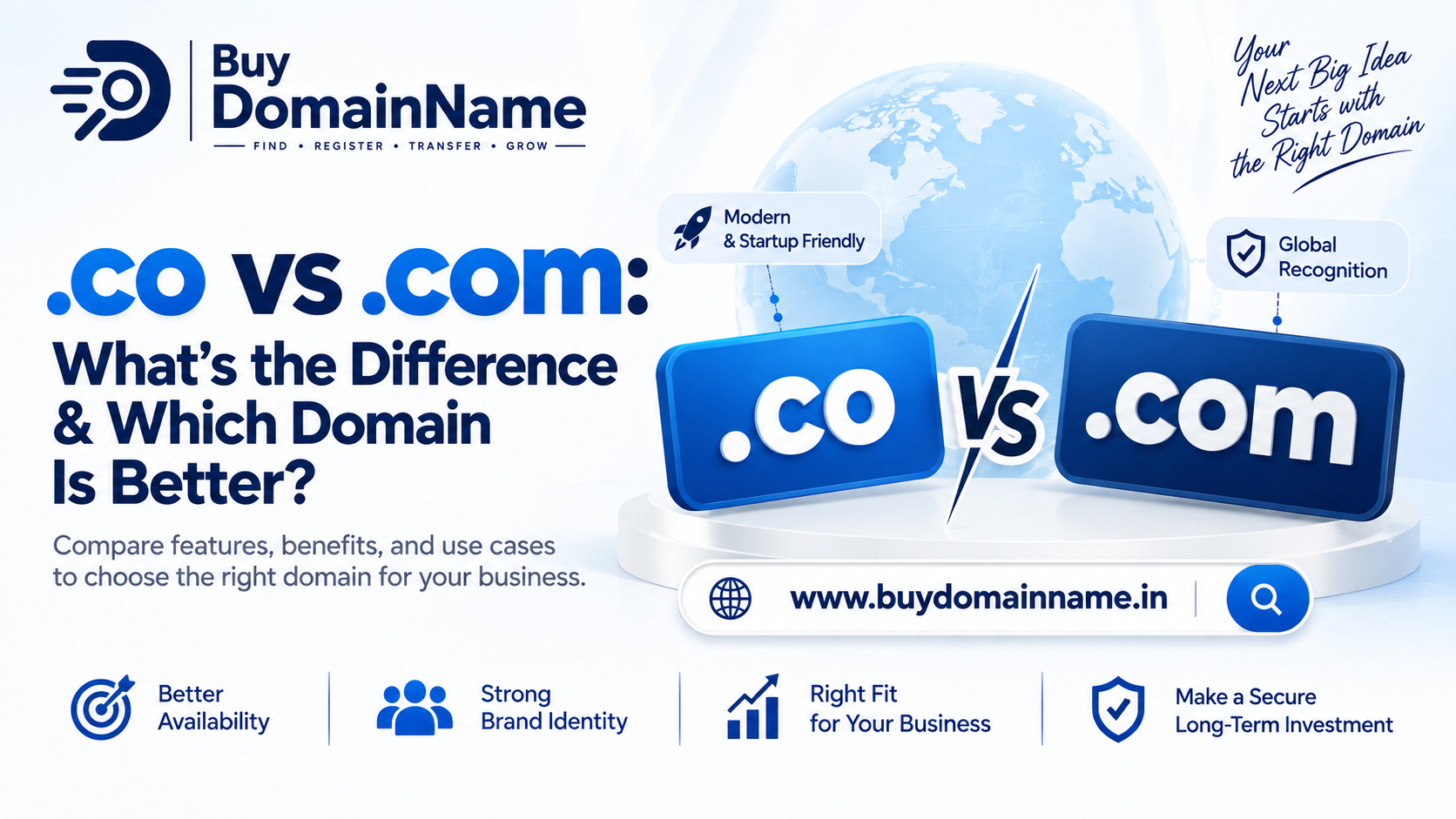
Among the many domain extensions available today, .com and .co are two options that businesses frequently compare.
The .com extension is globally recognized and has been the traditional choice for commercial websites for decades. The .co extension, meanwhile, has become increasingly popular with startups, technology companies, entrepreneurs, and modern digital brands.
So, which one should you choose?
Should you always prefer .com? Is .co a good alternative when your .com is unavailable? Does either extension provide an SEO advantage?
In this guide, we’ll explain the key differences between .co vs .com, including branding, trust, SEO, availability, business use cases, and long-term considerations.
.co vs .com: Quick Comparison
| Feature | .co | .com |
|---|---|---|
| Recognition | High | Very High |
| Global Familiarity | Strong | Excellent |
| Brand Perception | Modern and startup-focused | Established and universal |
| Domain Availability | Generally better | Highly competitive |
| Best For | Startups, technology and digital brands | Businesses across industries |
| Memorability | High | Very High |
| SEO Advantage | No inherent advantage | No inherent advantage |
| Global Expansion | Good | Excellent |
| Commercial Association | Strong | Very strong |
The main difference is straightforward: .com has stronger familiarity, while .co can provide more opportunities to secure a short and clean brand name.
What Is a .com Domain?
The .com domain is one of the most recognizable domain extensions on the internet.
The name originally came from “commercial,” but .com is no longer limited to traditional commercial organizations. Today, it is used by businesses, startups, ecommerce companies, software companies, agencies, creators, consultants, and many other types of websites.
Over the years, .com has become so familiar that many people automatically assume a company’s website will use the extension.
For example, if someone hears a company called “Example Brand,” they may naturally try example.com first.
This familiarity is one of the biggest strengths of .com.
A .com domain also gives a business a geographically neutral identity. Whether you eventually serve customers in India, the UK, the US, Europe, or other markets, the domain itself doesn’t restrict you to one country.
Why Is .com Still So Popular?
The biggest reason is simple: people know it.
Customers have encountered .com domains for years through websites, advertisements, search engines, emails, social media, and offline marketing.
When customers see a .com address, they generally don’t need an explanation about what the extension means.
That can be particularly valuable for businesses that depend heavily on brand recognition.
A .com domain can also work across almost every industry. You can use it for an ecommerce store today and expand into additional products and services later without the extension becoming irrelevant.
This flexibility is a major reason why .com continues to be the default choice for many businesses.
What Is a .co Domain?
The .co domain was originally introduced as the country-code domain for Colombia. Over time, it developed into a globally used domain extension and became particularly popular among startups, entrepreneurs, technology companies, and digital businesses.
The short two-letter format makes .co attractive from a branding perspective.
For example: yourbrand.co
looks clean, concise, and modern.
One of the biggest reasons businesses consider .co is that the corresponding .com domain may already be registered.
Instead of changing the brand name or using a complicated domain such as: get-your-brand-online.com
a business may be able to register: yourbrand.co
That can be a much cleaner branding solution.
Why Are Startups Choosing .co?
Startups often want short, memorable names that look good across websites, applications, social media profiles, and marketing campaigns.
This is where .co can be useful.
The extension has developed a strong association with entrepreneurship and digital businesses, so it can fit naturally with brands that want a modern identity.
A startup may choose .co when the exact .com isn’t available but the business doesn’t want to compromise on its core brand name.
For example, imagine a technology company called “Nova Labs.”
If novalabs.com is unavailable but novalabs.co is available, the .co version may allow the company to retain its preferred brand name without adding unnecessary words or numbers.
.co vs .com: Branding Differences
Your domain extension contributes to the first impression customers form about your business.
A .com domain generally feels familiar, established, and universal.
A .co domain often feels modern, concise, and startup-oriented.
Neither impression is automatically better.
It depends on what you want your brand to communicate.
For example, a global ecommerce company may benefit from the familiarity of: brand.com
while a technology startup may be perfectly comfortable with: brand.co
The important thing is consistency.
Your domain should match the positioning you are building across your website, logo, social media, email, advertising, and other customer touchpoints.
.co vs .com: Domain Availability
This is where .co has a significant practical advantage.
Because .com has been popular for decades, many short and obvious .com names have already been registered.
If you’re starting a new business, you may find that your ideal .com domain is unavailable.
At that point, you have several choices. You can modify your brand name, use a longer domain, purchase the existing domain from its owner, or consider another extension.
A .co domain can provide another option.
For example:
yourbusiness.com — unavailable
yourbusiness.co — available
If the .co version is short, memorable, and legally appropriate, it can be a much better business asset than a complicated .com alternative.
However, don’t choose .co simply because it is available. The quality of the complete domain name still matters more than the extension.
Does .co Have an SEO Advantage Over .com?
No domain extension should be treated as an automatic SEO advantage.
A .co website does not automatically rank higher than a .com website, and a .com domain does not automatically guarantee better Google rankings.
Search engines evaluate many other factors when determining search visibility.
These include:
- Content quality
- Search intent
- Website relevance
- Backlinks
- Technical SEO
- Website performance
- Mobile usability
-
Internal linking
- Website authority
- User experience
This means you shouldn’t select .co because you believe it will give you an SEO shortcut.
Likewise, you shouldn’t choose .com solely because you believe Google automatically prefers it.
Build a strong website first. The extension is only one part of your digital identity.
.co vs .com for Global Businesses
If your business is targeting customers internationally, .com generally has the stronger position.
The extension is globally familiar and doesn’t create a strong geographic association.
For example, a company planning to operate in India, the United States, Europe, and other markets can use:
brand.com
without customers assuming that the company belongs to one particular country.
A .co domain can also be used globally, but businesses should consider whether their audience is already familiar with the extension.
For a technology-focused audience, this is generally less of an issue.
For a broad consumer audience, the familiarity of .com can be more valuable.
.co vs .com for Startups
For startups, the decision is often more nuanced.
A startup may have a limited budget and may not want to spend heavily on a premium .com domain.
At the same time, founders don’t want to build their brand around a long or awkward website address.
This is where .co can be strategically useful.
If the exact .co domain is available and the name is strong, a startup can launch with a concise brand identity without waiting years or paying a large premium for the matching .com.
However, founders should think about the company’s long-term direction.
If the startup eventually becomes a major consumer brand, the familiarity of .com could become more valuable.
If it remains a technology-focused business with a digital-native audience, .co may continue to work extremely well.
.co vs .com for Technology Companies
Technology businesses are one of the strongest use cases for .co.
The short format fits naturally with:
- SaaS products
- AI startups
- Software companies
- Developer platforms
- Digital agencies
- Cloud services
- Online tools
- Technology communities
A technology brand doesn’t necessarily need to rely on .com to look professional.
A strong name combined with a clean .co domain can create a modern digital identity.
The critical factor is whether your audience understands and accepts the extension.
Technology audiences generally encounter alternative domain extensions more frequently than traditional offline audiences, so .co can feel completely natural in this environment.
.co vs .com for Ecommerce
For ecommerce businesses, .com usually has an advantage because customer familiarity matters.
When customers are shopping online, they want to know that they’re dealing with a legitimate and professional business.
A familiar .com domain can help reduce uncertainty.
However, a .co domain isn’t inherently unsuitable for ecommerce.
If the brand is strong and the website provides:
- Secure checkout
- HTTPS
- Clear contact information
- Transparent policies
- Customer reviews
- Professional design
- Reliable payment options
then the extension is only one part of the trust equation.
A business should evaluate the entire customer experience rather than assuming that the domain extension alone determines credibility.
.co vs .com for Small Businesses
Small businesses should think about their target market before choosing an extension.
If you’re running a local business that primarily serves customers who are not particularly technology-focused, .com may provide an advantage because people are more accustomed to it.
For example, a local:
- Restaurant
- Retail store
- Consultancy
- Service company
- Professional practice
may find .com more immediately familiar.
A technology-oriented small business, digital agency, or online-first company may find .co equally suitable.
Again, customer familiarity should drive the decision.
.co vs .com: Which Is More Trustworthy?
There is no universal rule that says one extension is trustworthy and the other isn’t.
Trust comes from the overall brand experience.
Customers consider things such as:
- Is the website secure?
- Does the company provide real contact information?
- Are reviews available?
- Is the website professionally designed?
- Are prices and policies clear?
- Is customer support accessible?
- Does the business have a credible online presence?
A .com domain can provide familiarity, but it cannot compensate for a poorly managed website.
Similarly, a professional business using .co can establish strong customer trust through good branding, security, transparency, and service.
Is .co a Country-Specific Domain?
This is an important point for beginners.
The .co extension was originally associated with Colombia, but it is now widely used internationally.
Businesses in many countries use .co for branding, particularly startups and digital businesses.
So, if you’re considering a .co domain for a global business, you aren’t limited to operating in Colombia.
However, because it originated as a country-code domain, businesses should understand the history and positioning of the extension before making it part of their brand strategy.
.co vs .com: Marketing and Memorability
A domain needs to work outside your website.
You’ll use it in:
- Social media profiles
- Email signatures
- Business cards
- Advertisements
- Packaging
- Presentations
- Videos
- WhatsApp messages
- Printed materials
Both .co and .com are short, but .com has a major familiarity advantage.
If someone hears:
“Visit our website at brand dot com”
most people immediately understand what to do.
With .co, you may occasionally need to clarify that the website ends in .co rather than .com.
That extra clarification isn’t a major issue for many digital businesses, but it can matter when your audience is broad or heavily dependent on word-of-mouth marketing.
Should You Register Both .co and .com?
If both versions are available and your brand is important, registering both can be a smart brand protection strategy.
For example:
Primary domain: yourbrand.com
Secondary domain: yourbrand.co
You can use one as the main website and redirect the other to it.
This gives you control over both versions and reduces the possibility that another party registers the alternative domain and creates confusion.
You don’t need to build two separate websites.
One domain can remain your primary website while the other simply redirects to it.
For growing businesses, this can be a relatively straightforward way to protect a valuable brand name.
What If My .com Domain Is Already Taken?
Don’t panic.
This is extremely common.
Start by checking whether the existing .com is actively being used.
If it belongs to an unrelated business, you need to be particularly careful about brand confusion.
If the domain is simply parked or listed for sale, you may have the option to purchase it—but premium .com domains can be expensive.
Before spending a large amount of money, compare alternatives.
A clean: yourbrand.co
may be a better business decision than spending a large amount on a premium .com.
You can also explore other relevant domain extensions depending on your industry and audience.
The goal should be to secure a strong, memorable, legally appropriate domain, not to force yourself into .com at any cost.
What Should You Check Before Registering a .co or .com Domain?
Before you register your domain, look beyond availability.
First, make sure the domain is easy to spell and pronounce. If customers regularly ask how to spell your business name, your marketing will become unnecessarily difficult.
Next, check whether the name is already associated with another company or trademark. Domain availability does not automatically mean that the business name is legally safe to use.
You should also check the availability of the name across major social media platforms. Consistent branding across your website and social channels makes it easier for customers to find and remember your business.
Finally, check the renewal price, not just the promotional first-year registration price. A domain is a long-term asset, so understanding the total cost of ownership matters.
Common Mistakes to Avoid
Choosing a Complicated .com
Don’t choose a long and confusing .com simply because you believe every business must have one. A clean .co can sometimes be the stronger brand.
Assuming .co Is Automatically Better for Startups
.co has strong startup associations, but that doesn’t mean every startup should use it. Your audience and business model still matter.
Choosing Based Only on SEO
Neither extension is a magic SEO solution. Focus on content, technical performance, authority, relevance, and user experience.
Ignoring Customer Expectations
Think about what your customers expect when they see your website address.
Forgetting Brand Protection
If your brand becomes valuable, consider whether securing both .com and .co makes sense.
.co vs .com: Which Domain Should You Choose?
The answer depends on your business.
If your preferred .com domain is available, the combination of familiarity, recognition, and global flexibility makes it a very strong choice for most businesses.
If your desired .com is unavailable, however, you shouldn’t automatically choose a long or awkward alternative.
A strong .co domain can be an excellent option, especially for startups, technology companies, SaaS businesses, entrepreneurs, and digital-first brands.
Choose .com when:
- You want maximum familiarity
- You’re targeting a broad consumer audience
- You operate an ecommerce business
- You’re building a global brand
- Your preferred .com is available
- Long-term mainstream recognition is important
Choose .co when:
- Your preferred .com is unavailable
- You want to preserve your exact brand name
- You’re building a startup
- You’re operating a technology business
- You want a short and modern domain
- Your audience is comfortable with digital-first brands
Consider both when:
- Your brand is strategically important
- Both domains are available
- You want additional brand protection
- You have the budget to secure both
Final Verdict: .co vs .com
So, which domain is better—.co or .com?
For most businesses, .com remains the strongest default choice when the exact domain name is available. Its global familiarity, long history, and broad industry acceptance make it an excellent foundation for a long-term brand.
But .co should not be dismissed as merely a backup.
If your preferred .com domain is unavailable, a short and memorable .co domain can be a very strong alternative. It can be particularly effective for startups, SaaS companies, technology businesses, entrepreneurs, and modern digital brands.
The important thing is to avoid compromising your brand just to obtain a particular extension.
A clean: brand.co
can be better than: get-brand-online-123.com
The domain extension is important, but the complete domain name and the brand behind it matter more.
Think about your audience, business model, marketing strategy, and long-term plans before making the decision.
If both versions are available and your brand is important, registering both .com and .co can provide additional brand protection.
Find Your Perfect Domain at BuyDomainName.in
Your domain is one of your most important digital brand assets. Whether you’re launching a startup, ecommerce store, SaaS platform, agency, technology company, or personal brand, the right domain can provide a strong foundation for your online presence.
At BuyDomainName.in, you can search for available domain names and explore different extensions that fit your business.
Looking for maximum familiarity?
Search for your .com domain.
Your preferred .com isn’t available?
Explore .co as a clean and modern alternative.
Want to protect your brand?
Consider registering both.
Don’t wait until someone else registers the name you want.